Esai Santos: My Best Self
A Portrait of the Player as a Young Man
by Roberto Santiago
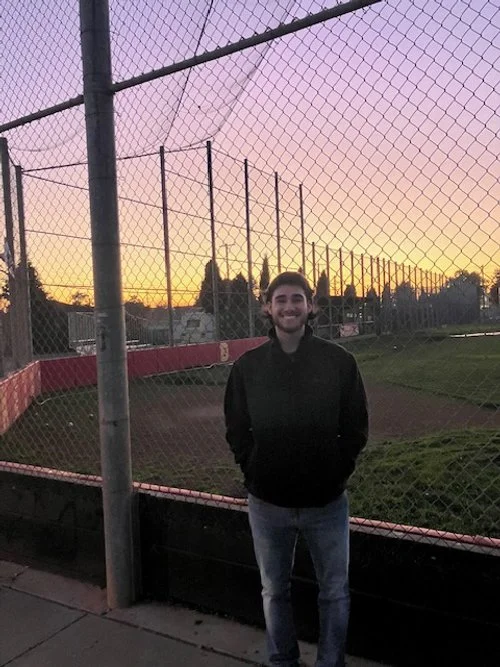
Esai Santos sits in the right field bleachers at Tim Moellering Field, home of the Berkeley High Yellowjackets, thinking about how to answer my question about his childhood. “I feel like growing up in Berkeley, you get to experience a lot in terms of what you see, who you’re around. You’re definitely going to get a mix of anything you can think of. I would say a lot of activism, being outspoken.” Santos was born and raised in Berkeley, where his mother also grew up. He is the youngest of three brothers who all played baseball at Berkeley High at various times. “It also comes with societal things, a lot of political issues that are right in front of you. There was a protest at Cal that I was a part of. I was part of a number of protests at Berkeley High, walking out and stuff.”
We are sitting here on a chilly December afternoon to talk about Santos’s path from an undersized and overlooked high school shortstop to a key member of the Oakland Ballers team that brought The Town its first baseball championship in 26 years.
Esai Santos, courtesy Roberto Santiago
High School: Building Slowly
Looking out at the field where he played his high school ball, Santos reflects, “Berkeley High shaped me. It’s intimidating when you first go on campus as a freshman. You see so many different things and so many different people. And I was small, too. So that probably contributed to me keeping to myself and having a little shell.” Berkeley High, sitting on 18 acres in the middle of town, is the city’s only public high school, enrolling around 3,200 students. Santos and Curtis Sandeford, Berkeley High’s head coach from 2016-2024, joined the varsity baseball program together in 2016 and enjoyed immediate success. The team went 20-7 that year, losing in the 2017 league championship game. The next year saw Santos’s best and worst moments of his high school career. The best was beating Alameda for the league title. The worst was losing to Freedom High School in the first round of the North Coast Sectional tournament directly afterward. This was the first data point in a pattern of Santos coming close to a championship but falling short.
Sandeford remembers seeing Esai taking batting practice, with his father pitching, when Santos was five years old. “He loves the game,” Sandeford recalls. Sandeford, who had previously coached at BHS with revered coach Tim Moellering, also coached the older Santos brothers. Sandeford remembers Santos as a quiet kid who needed to be drawn out, but one who was also a devoted teammate and positive presence on and off the field. “Esai was a hard worker. We had a lot of good players. It was competitive. We had a lot of good infielders; he had to kind of wait his turn.” Working hard didn’t translate to immediate statistical success. Santos hit .245 with 22 RBI over 45 varsity games. Still, Sandeford remembers him as a good hitter who was always working to get better. After graduation, Santos asked Sandeford for a key to the batting cage at Moellering so he could continue to work on his swing.
While Santos’s skill with the bat wasn’t always showing up in the box score, his baseball IQ was regularly on display. Santos’s travel ball coach, Enrique Padilla, remembers Santos as one of the smartest players he’s ever coached. Padilla played with Santos’s brothers, who he recalls telling him, “Wait ‘til you see Esai. He’s the best of all of us.” One play that stood out for Padilla as an example of Santos’s baseball intelligence came when his U17 team was playing a squad of college players. With the bases loaded and one out, the batter hit a line drive right to Santos. “Most short stops would just catch the ball and look for the next play,” Padilla recalled. “Esai knocked it down with the back of his glove. As soon as it hit the ground, he started the double play.”
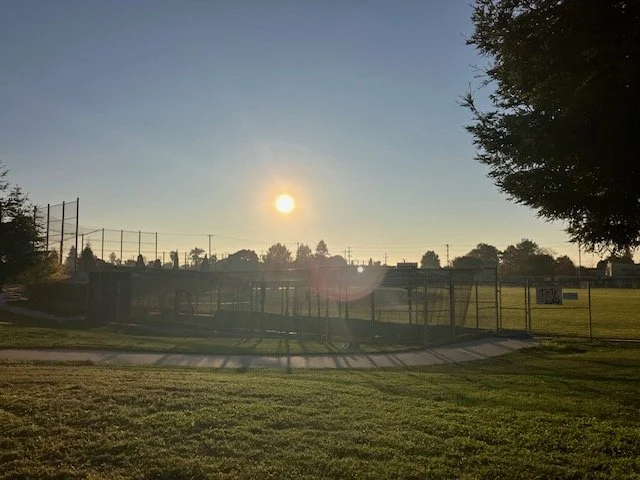
Tim Moellering Field, courtesy Roberto Santiago
College Years: Wanting More
It turns out that light-hitting, undersized shortstops don’t get a lot of attention from college scouts. Still, Santos knew he wasn’t done. “I think that’s the most overlooked aspect of my career because those two years in high school were obviously not good, but my goal was to just continue playing in college. So I knew there was a lot more to do to get better and keep building slowly.” Santos went to a Division III school in southern California. (He declined to say which one.) There, he was relegated to the JV team, which only played eight games and, according to Santos, “wasn’t much of a team. We practiced like, twice a week.” Santos returned to school in the fall, and despite feeling like he’d had a good tryout, he was told he’d be on JV again. “That’s when I looked myself in the mirror and said I wanted more for myself. So that’s when I decided to transfer to Laney for the spring of 2020, and two months in, Covid happens.” With his season cut short and an injury further reducing his playing time, Santos returned to Laney for the 2021 season.
It’s at this point that another pattern started to emerge–his tendency to play better as the level of competition increased. Santos hit .393 over 26 games at Laney, which was enough to earn a transfer to Holy Names University in Oakland. In 101 games at Holy Names, Santos hit .370 with 66 RBI. With a year of eligibility left, Santos enrolled at Point Loma Nazarene University in San Diego, earning a master's in Kinesiology and Sports Management while also hitting .346/.419/.547 with 53 RBI and a career high 10 home runs. With Santos, PLNU won its third straight PacWest championship and the West Regional tournament, earning a spot in the Division II College World Series. That season ended with a 1-0 first-round loss to Indiana University of Pennsylvania.
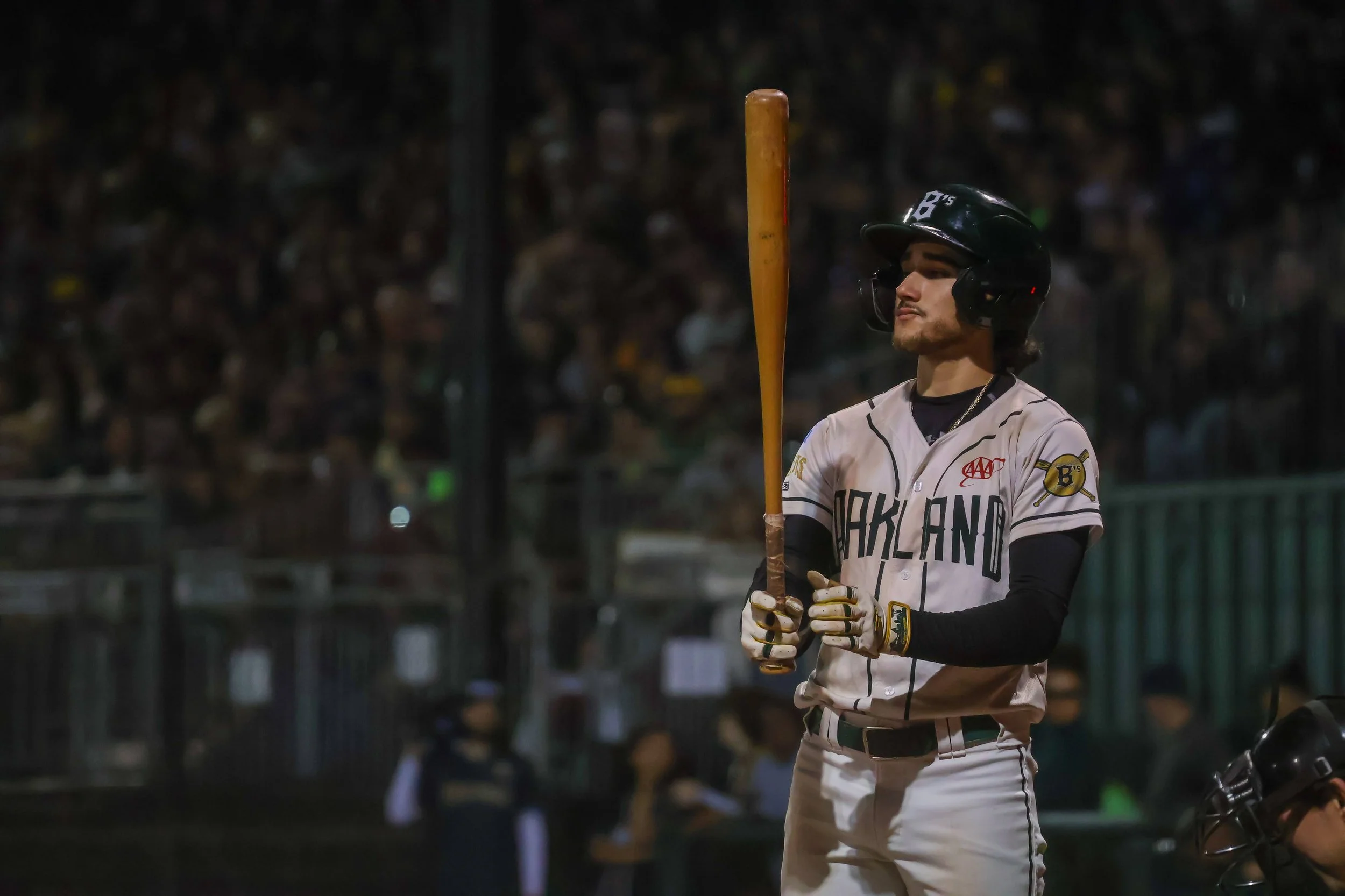
Courtesy Randy Mai and the Oakland Ballers
First Steps as a Pro
When his time in San Diego was over, Santos again returned home to the Bay to play for the San Rafael Pacifics of the Pecos League. Starting play in 2011, the Pecos League is the first professional experience for many aspiring ball players. The competition is a step below the Pioneer League, and they claim to be the only league in the world that doesn’t use a designated hitter. Players drive themselves to away games, often on a tight turnaround. “We would play a game at home,” Santos recounts, “wake up, drive to Bakersfield, play that night at an 8 o’clock start time when it’s still 95 degrees, play again the next day, then wake up the next morning after that to drive home and play a home game.” Santos was happy to still be playing ball, but it’s not an experience he’d readily relive. San Rafael was coming off a league championship the year before, and Santos stepped right in to keep things rolling. He hit .292 and was named as the shortstop for the West All-Star team. The Pacifics returned to the championship series. After playoff disappointment at each previous stop, Santos again came up just short as the Pacifics fell to the Alpine Cowboys of Texas in a sweep.
Santos had missed the Ballers' open tryout in San Diego in 2024. He made sure to attend the open tryout in March 2025. He wasn’t offered a contract, but B’s manager Aaron Miles was in touch afterward. Says Miles of that first tryout, “I loved the college stats, loved the swing. I didn’t know how good of an infielder he was. He didn’t seem special at it. I was also hesitant because of his size.” Still, Miles knew Santos was a prospect he wanted to circle back to. “He was a Bay Area guy who had a good chance to make the team. I hoped he would fly under the radar [in terms of interest from other clubs] and be an extra guy for us. I thought maybe Yuba would take him when he went to their tryout.”
Santos told Miles he would also be at the Pioneer League tryout in Arizona a month later. Arizona was a three-day event not unlike the scene in A League of Their Own, with players auditioning for all of the Pioneer League teams at once. Like in the movie, the showcase ended with a live draft with all of the prospects present. “All the teams were there,” Santos says. “A couple of the teams had come to talk to me during the tryout. Funny enough, Aaron never came up to me.” Miles admits now that he didn’t want to tip his hand. "One hundred percent!” he says. “I didn’t want anybody to see me talking to him. I knew he was our first pick. We had the 11th pick or something. I didn’t want anyone to know I was on him.”
Another similarity to the movie: one might think that in the years between 1943 and 2025, with advanced scouting and analytics, it might take a day or two for front offices to make a decision. According to Santos, “It was 15, maybe 20 minutes of the coaches talking to their people about who they wanted to pick.” The movie parallels continued: “Then all the players were gathered around, and they started calling off names. It was a weird feeling in my stomach, like, am I going to be called by this team that had talked to me?” It was awkward, like picking teams on the school yard. “There was a lot of talent there. There were guys who I thought might have been called, but they weren’t.” In the end, Santos was picked, and he was coming back—once again—to play baseball in front of friends and family.
The process was also nerve wracking for Miles as a coach. “We lucked out. We didn’t know he was that good. We could have missed out on him. Maybe we shouldn’t take that chance again [of giving other teams a chance to sign desired players]. Just ink a guy if you like him.”
“Thankfully, the Ballers got me,” Santos says. “It was a relief. I was excited, but I knew it was just another step in the process of actually making the team.” Getting drafted didn’t mean he would be a Baller. He still had to win a job in spring training, and though Miles liked him, he didn’t see Santos as a sure thing. Santos showed enough in the spring to make the team, but according to Miles, “I projected him as a utility guy who played every now and then. A late-inning left-handed pinch hitter off the bench.” But that was all Santos needed–a foot in the door.
Courtesy Randy Mai and the Oakland Ballers
Finally, a Baller
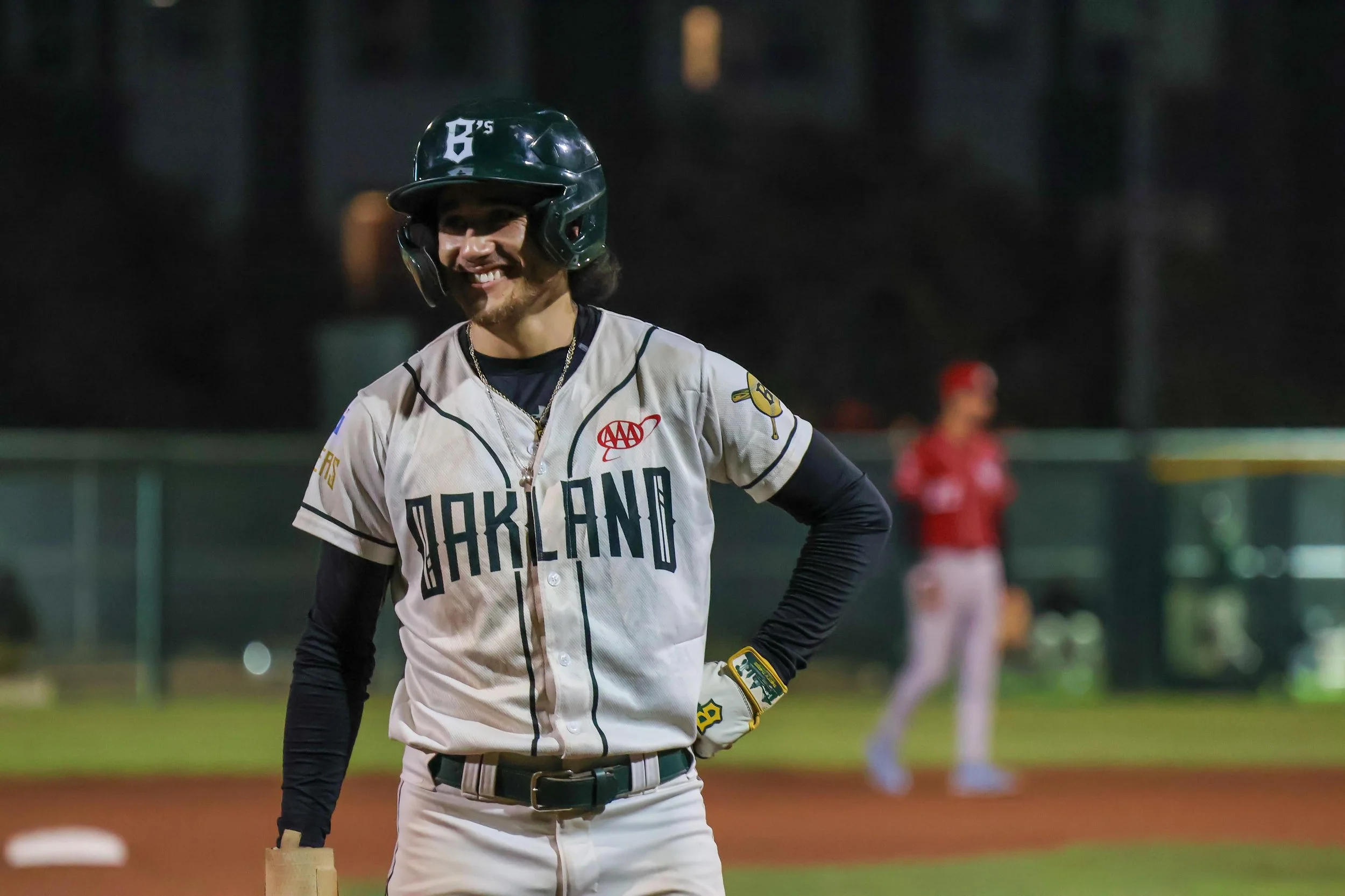
Santos had a good season, hitting .289/.428/.488 with 47 RBI and 11 home runs. Santos’s early season mirrored that of the Ballers' up-and-down start. While he appeared in every game, his usage varied. In the first 15 games, Santos split time between second base and right field, also appearing as a pinch hitter and logging one scoreless inning as a pitcher–the Ballers were losing 12-5 to Ogden and Miles wanted to save his bullpen. “I hadn’t pitched since Little League,” says Santos. “I think Aaron went up to everyone, and when he got to me, I was excited to do it.” Miles had a slightly different recollection, “I was like, you're the local guy, you’re the 26th man, you gotta do this.”
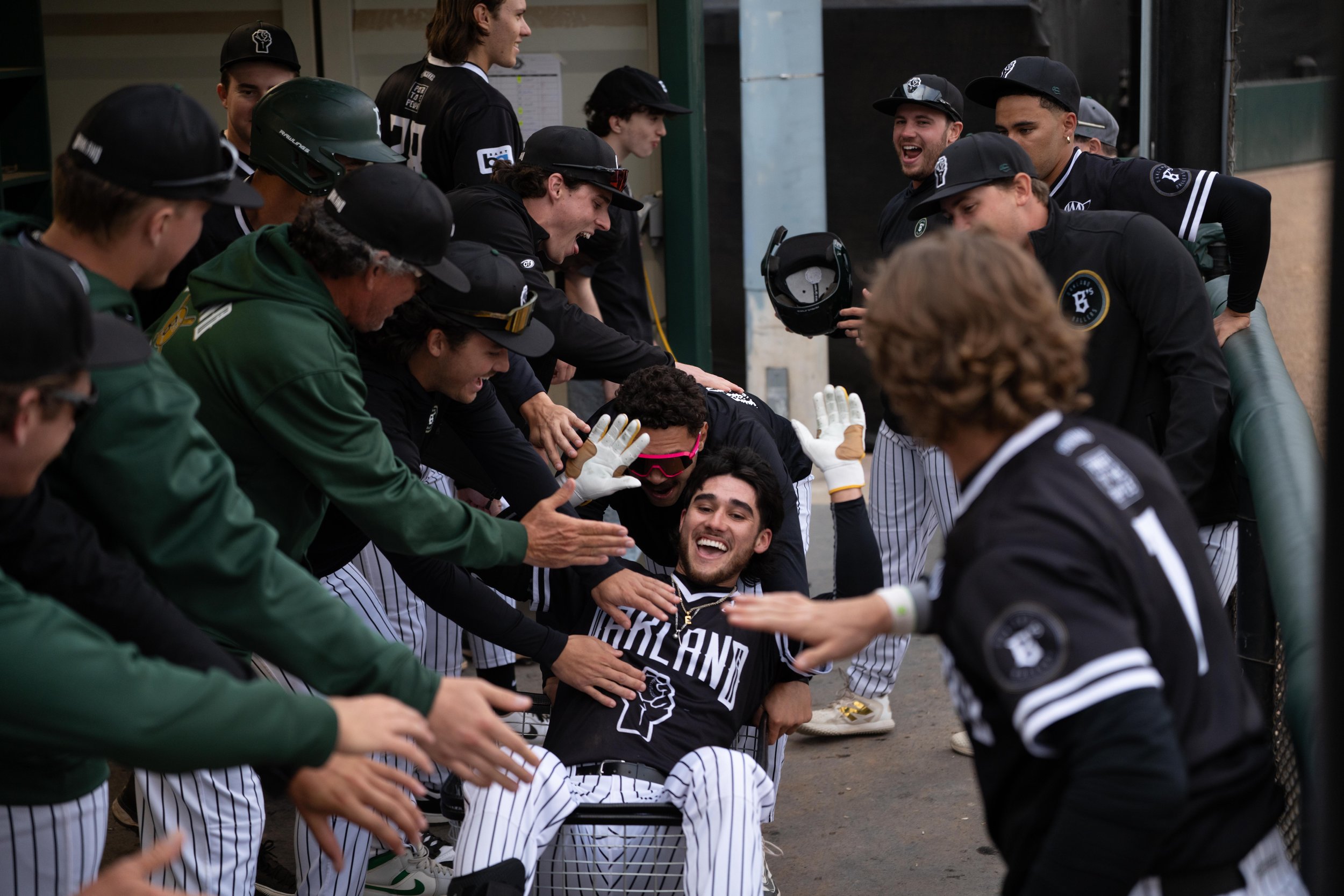
The Ballers went 7-5 on their opening home stand and did not always look like a team destined to win a championship. Both Santos and the team hit their stride once the calendar ticked over. The Ballers started to heat up in June and late in the month, after splitting time between nearly every position on the field, Santos settled in as the everyday right fielder. “It was a similar experience to college, where I could play second, but the best thing for the team was for me to be in the outfield. If I can just get myself into the lineup, that’s worth something.” And it was worth something to the Ballers. Santos ended the season fifth in games played and led the team in both walks and being hit by pitch. According to Miles, “I remember the day I thought, we need to play this guy more. We were in Glacier and he lined up some balls off some good pitching. I thought, I’m undervaluing this kid. He’s better than I thought. He needs to be in the mix more. We had some outfielders but he ended up outplaying everybody.” He showed his value off the field too, giving haircuts to teammates as he’d been doing since high school. Along the way, the Ballers set a modern-day Pioneer League record with 73 wins.
Courtesy Tobin Haas-Dehejia and the Oakland Ballers
Santos also showed up in critical moments in the playoffs. In the first round series against Ogden, though he hit just .143, he added two walks for a .428 OBP while also contributing in the field. In the decisive Game 3, Santos was involved in one of the strangest baseball box scores in a while. After making a sliding grab for an out in the top of the 7th, Santos came to bat with pinch runner T.J. McKenzie on second. After drawing a walk, Santos and McKenzie attempted a double steal. The throw to second was offline, and McKenzie scored standing up. It would end up being the only run of the game. McKenzie, signed late in the year, served as a catalyst on the bases during the playoff run. “T.J. brought a lot of speed,” says Santos. “He’s another guy we knew we could plug into the lineup, play in the outfield, and put us in a good spot.”
In the first two games of the championship series against Idaho Falls, Santos hit .444 with two RBI, but the Ballers lost both games. It was in the last three games, facing elimination, that Santos really made an impact. Coming home down 0-2 in the best-of-five series, the team was still loose. How does a team with multiple ten-plus game win streaks stress about having to win three in a row? They don’t. “If anyone was nervous, they didn’t show it,” Santos says. “We’re the best team in the league. How can you not have confidence in yourself as the best team in the league?” Besides, as team co-founder Paul Freedman remarked on the concourse during Game 4, “We knew we were coming home to Oakland and the Idaho players weren’t ready for the environment at Raimondi.”
On this early December day in Berkeley, Santos still remembers the series well–“If we could win that third game, that’s like winning two games, just because of how much baseball is a momentum sport”–and he recounts some of his favorite moments. In Game 3, Idaho Falls left fielder Eddie Pelc hit a towering drive to left-center field, a ball that was destined for Campbell Street. Santos recalls, “I see [center fielder Davis] Drewek going back and he’s tracking it well. Once he went up for it, I had a good feeling he was going to come down with it.” Drewek made a leaping catch to snag the ball over the wall, robbing Pelc of a home run. “That also set the tone for the game and the next two after that. That was such a huge momentum builder.” In the top of the eighth inning in Game 4, Santos got to revel in another fantastic catch by one of his fellow outfielders. With two out and a runner on second, left fielder Michael O’Hara chased down a foul ball, making the catch while crashing into a chain-link fence. “I don’t know how he stuck with that after tracking it all the way to the fence and then crashing into it,” Santos remembers. “Another momentum shift.”
And a few of the big shifts in the series were courtesy of Santos himself. Game 4 hadn’t started well for Oakland as Idaho Falls held a 2-0 lead heading into the top of the fifth inning. It looked like the Chukars would add to their lead when they had runners on first and second with two outs. The game turned when Chukars’s center fielder, Spencer Rich, stroked a solid single to right, fielded by Santos, who, for the second night in a row, hosed the runner at home plate, ending the threat. Santos recalls, “In that moment, I’m thinking, they probably shouldn’t run on me anymore.”
Aaron Miles in the dugout and Enrique Padilla watching from the stands remember it as a—maybe the—turning point. According to Miles, “That may have been the play of the series. He’s an IF playing OF with that quick transfer and strong arm. That was a huge play.” In the bottom of the same inning, Santos scored the go-ahead run.
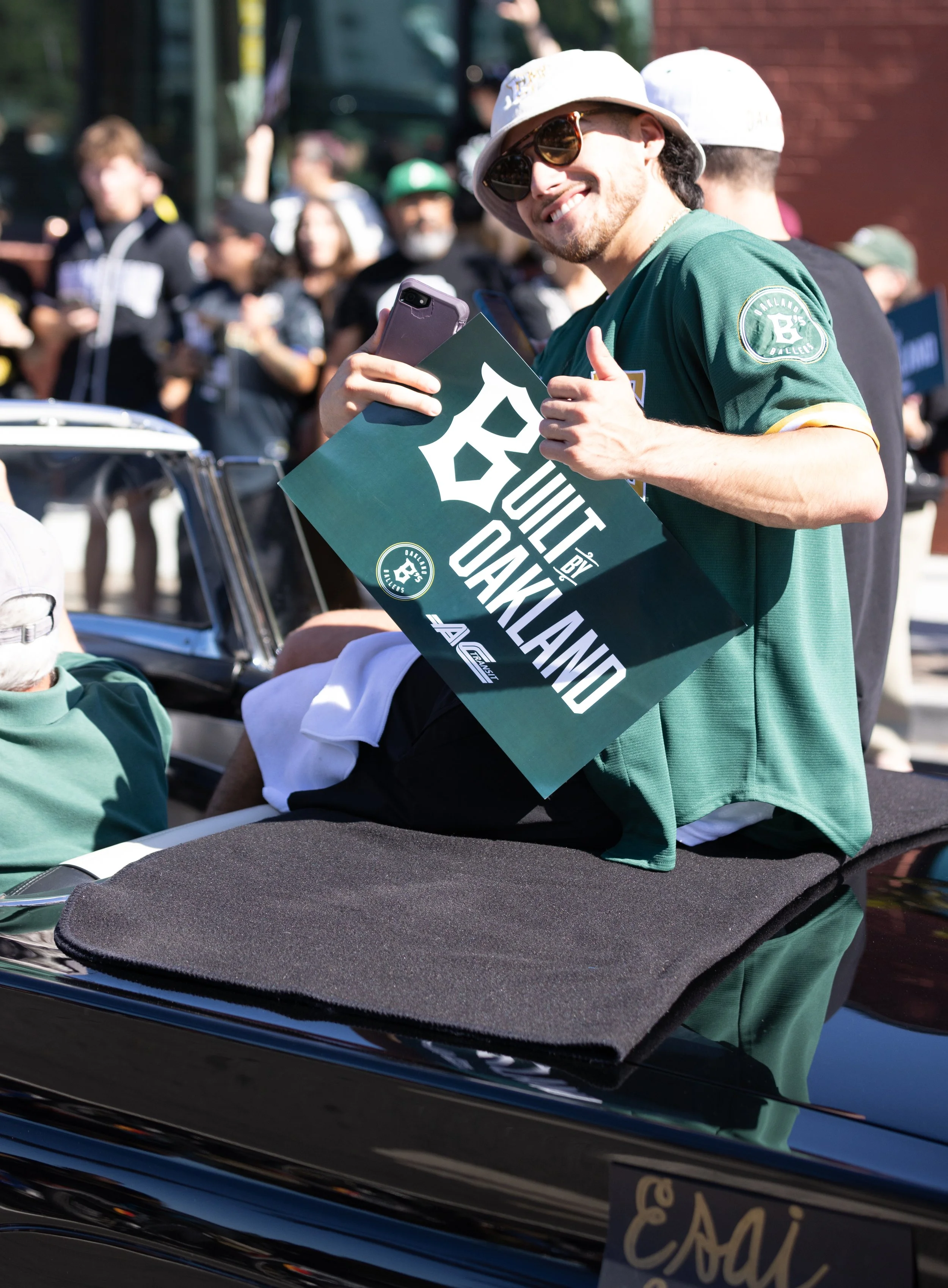
Unlike most of the series, Game 5 was never in doubt. The Ballers jumped out to an early lead and never looked back. Idaho Falls managed one run in the ninth when the game was out of reach, and when Connor Sullivan struck out Idaho Falls’s Grady Morgan, Oakland had an 8-1 victory, bringing the city its first pro baseball championship since 1989. “The last pitch was definitely special,” says Santos. “I didn’t even look at the fans or nothing. I started yelling, and I started running towards center field because after each win, we would come together and play rock-paper-scissors. So, we did that, and then we’re like, oh. Everyone’s in the infield right now.” Santos and his fellow outfielders joined their teammates, jumping around while “Celebration” by Kool & the Gang played over the PA. In a cinematic moment, fire trucks parked beyond the left field wall began to douse the field with water at a parabola that mimicked a cascading rain. The players, staff, and family members on the field ran through the spray in jubilation.
Santos, undersized and overlooked, the native son of Berkeley, California, and East Bay to the bone, had brought a championship to a city and a fan base longing to heal from years of neglect.
Courtesy the Oakland Ballers
Back with the B’s
Re-signing with the Ballers this offseason was an easy decision. Living at home brings a sense of comfort and belonging. “I feel very connected to this city,” Santos says of Oakland. He also knows he isn’t finished developing as a player. “For me, there’s just more for me to prove in this league. After that, we’ll see, and we’ll reevaluate.” Santos has been coaching at Laney College, where he once played. “I’m sort of an assistant to everyone. Offense, defense, infield, outfield. I try to help with the mental side, trying to help them process the game a little slower. I was in their shoes five years ago. I think that helps me connect with them. I’m there for them.” Santos thinks about why he enjoys coaching: “I want to give them as much knowledge as I can to help them get to the next level they’re trying to get to.”
Padilla, the travel ball coach, sees greatness in Santos in that realm as well. “We host a really big high school training camp,” says Padilla, who invited Santos out to help as an instructor. “We gave him 15 kids and asked him to run some drills. He impressed us with how fluent he was with his knowledge and his ability to express it to the kids. It was honestly some of the best infield coaching I’ve ever seen and I’ve been doing this for 15 years.”
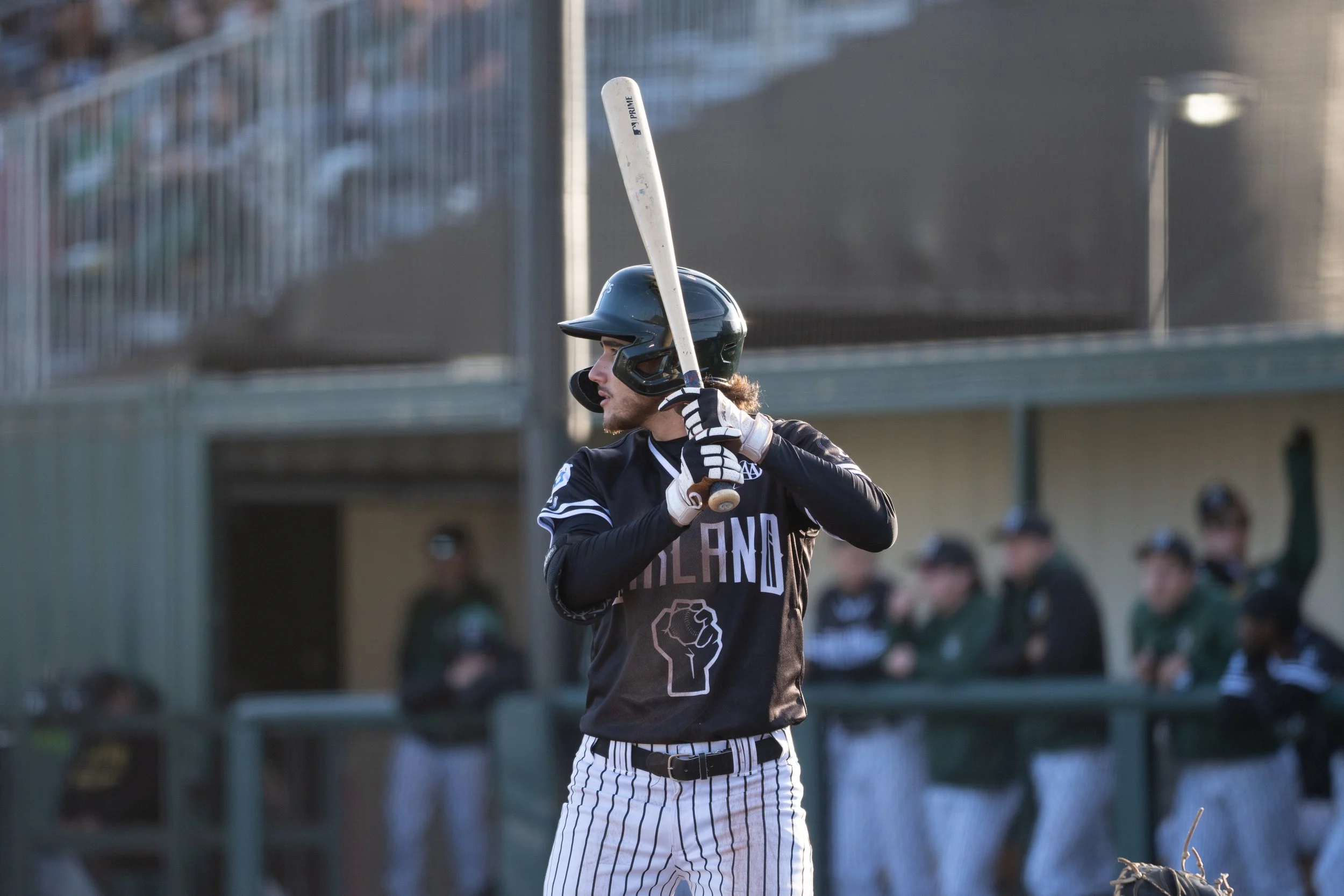
The question of life after baseball lingers. The Pioneer League ages players out after three seasons of professional ball. “Coaching at a junior college is something I can see for myself in the future. A perk of having a master’s is that you can become a head coach at the junior college level.” The Ballers, meanwhile, have sold the contracts of four players to teams affiliated with the major leagues. This year, a number of players from the 2025 title team have left for clubs in higher levels of independent ball. Still, the life of a ball player is largely in the hands of other people. “It’s really whatever teams are looking for,” says Santos. “That’s something you can’t control, and I tell myself that a lot. So, I just try to worry about what I’m doing and let things fall into place.” One person who believes Santos has more years ahead of him as a professional is his manager. “He’s one of the best prospects in the league,” Miles says. “He has a chance to play at a higher level. Could go to affiliated ball. He could be a CF at a higher level. He has speed. He’s one of the better OFs in the league.”
Courtesy Tobin Haas-Dehejia and the Oakland Ballers
It’s become considerably colder at Moellering Field as dusk settles in. Santos considers what keeps him playing despite having other, potentially more lucrative options. “It’s because I love it. I love playing. The fact is, I haven’t reached my full potential. I’m not going to stop doing something I love and that I know I’m not my best self at yet. The master’s will always be there. The money will always be there in the future. I’m enjoying playing baseball still. So, I figure if I can do it, then I’m going to do it.”
Esai Santos has always been able to meet the moment. Even when he wasn’t filling up the box score, at every stop, he was a valuable member of teams that won more–often a lot more—than they lost. Now, he’s putting up better numbers the higher he climbs the baseball ladder.
If he can do it, he’s going to do it.
Roberto Santiago is a third generation Berkeley boy currently raising the fourth generation. Roberto’s writing has appeared in Latina, Parents, and various online outlets. A lifelong baseball fan, Roberto worked briefly with the Boston Red Sox and once hit an RBI single off Spaceman Lee on a 2-2 changeup. It was his only at bat ever in a real baseball game. Find him on Instagram.